
📸 -
Chronicles, Stories & Shards of Memory
Welcome to our lineage scrapbook. Through these life stories, rediscover family anecdotes, memories and shards of history.
🔍
📸 2026-05-31
General
📅 2026-05-31
L'origine historique des noms canadiens
✏️ Written by Sylvain Lagacé
Le nom de famille, un besoin vital de se distinguer
1. L’explosion démographique et le besoin de distinguer
Au XIe siècle, l'Europe connaît un essor de population. Dans un village où dix hommes s’appellent « Jean », la confusion règne. Pour les différencier, on ajoute un surnom d'usage basé sur des faits concrets :
- Le lieu : Jean qui habite près du pont devient Jean Dupont.
- Le métier : Jean le forgeron devient Jean Lefebvre.
- Le trait : Jean le petit devient Jean Petit.
À cette époque, le nom n'est pas encore héréditaire. Le fils de Jean le Petit pourrait très bien devenir « Pierre le Grand » s'il dépasse son père en taille.
2. L’administration : Le grand fixateur
Le passage du surnom oral au nom de famille écrit est le fruit de la bureaucratie.
- 1539 (France) : L'Ordonnance de Villers-Cotterêts impose aux prêtres de tenir des registres de baptêmes. Pour la première fois, le nom du père est systématiquement attribué à l'enfant dans un document officiel.
- 1794 (Loi du 6 fructidor) : Après la Révolution française, l’État interdit formellement de changer de nom ou d'utiliser des pseudonymes sans autorisation. Le nom devient une propriété de l'État pour mieux identifier les citoyens, les soldats et les contribuables.
3. Le phénomène des « Noms-dits » en Amérique du Nord
En Nouvelle-France et en Acadie, une tradition unique brouille les pistes : le nom-dit. Les colons ajoutent un second surnom à leur patronyme d'origine.
- Identité militaire : Les soldats arrivant au Québec reçoivent un « nom de guerre ». C'est ainsi que la famille Mignier devient Mignier dit Lagacé (en référence à la gâchette d'un fusil).
- Éclatement des lignées : Au fil du temps, l'usage du « dit » disparaît, forçant les familles à choisir l'un des deux noms. C’est pourquoi deux frères au XIXe siècle ont pu fonder deux lignées distinctes : l'une gardant le nom d'origine (Miville) et l'autre adoptant le surnom géographique (Deschênes).
4. L'orthographe : Une science imprécise
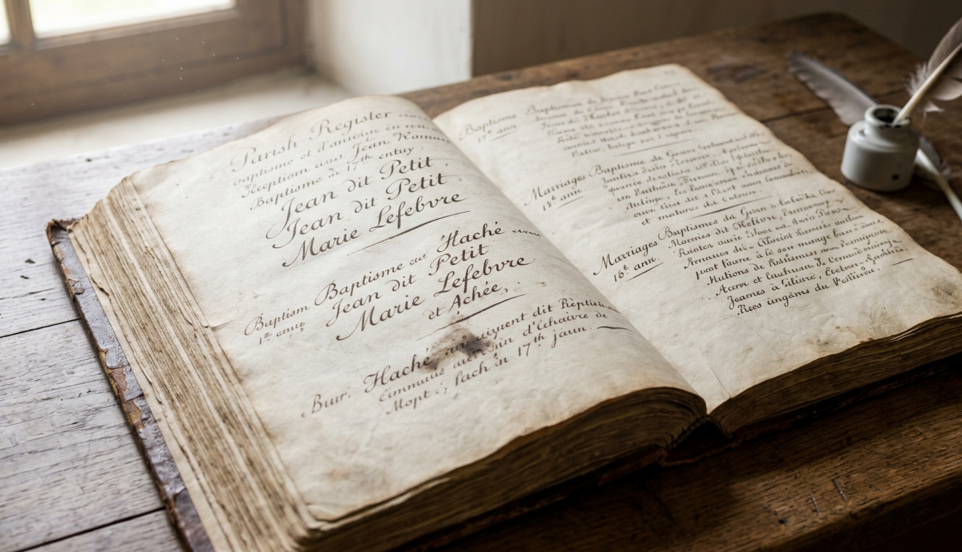
Jusqu'à la fin du XIXe siècle, l'orthographe des noms reste fluide. Les registres paroissiaux étaient remplis par des curés qui écrivaient « au son ». Un nom comme Haché peut ainsi dériver de Larché ou Achée selon l'oreille du scripteur et l'accent local. L'alphabétisation de masse au XXe siècle a finalement « gelé » ces variations, transformant des erreurs de plume en patronymes officiels.
5. L'oreille du curé : La déformation des registres
Avant la généralisation de l'instruction et des pièces d'identité modernes, l'orthographe d'un nom de famille n'existait pas en tant que concept fixe. Le nom était une entité sonore, et son passage à l'écrit dépendait entièrement du scribe (souvent le curé ou un officier civil).
Plusieurs facteurs expliquent ces déformations permanentes :
- La transcription phonétique : Le curé écrivait ce qu'il entendait. Un accent régional prononcé ou une mauvaise articulation du déclarant pouvait altérer radicalement le nom. Le nom Haché, par exemple, a connu des dizaines de variantes dans les registres acadiens et québécois (Achée, Haché, Ash, Hachey) avant de se stabiliser.
- L'analphabétisme des parents : Jusqu'à la fin du XIXe siècle, la majorité des parents « déclaraient ne savoir signer ». Ils ne pouvaient donc pas corriger le curé s'il omettait une lettre ou modifiait une syllabe. L'erreur du premier registre devenait alors la vérité officielle pour toutes les générations suivantes.
- L'omission de particules : Des noms comme Deschênes ou Lagacé ont souvent perdu leur majuscule, leur trait d'union ou leur particule d'origine au gré des inscriptions rapides. Un « Mignier dit Lagacé » pouvait se voir inscrit simplement comme « Lagacé » par un prêtre pressé, effaçant d'un trait de plume le patronyme originel.
- L'anglicisation involontaire : Dans les régions limitrophes ou lors de migrations vers les États-Unis, des noms français ont été déformés par des greffiers anglophones. Bélanger est devenu Baker, Aucoin s'est transformé en Wedge, et Vaillancourt a pu devenir Vancour.
Cette « science imprécise » a fait en sorte que, pour une même lignée, on retrouve parfois trois orthographes différentes dans un seul arbre généalogique, figées à jamais par l'arrivée de la bureaucratie moderne.
Conclusion
Nos noms de famille ne sont pas de simples étiquettes ; ce sont des fossiles linguistiques. Ils racontent le métier d'un ancêtre, la topographie d'une terre disparue ou le courage d'un soldat. Porter un nom aujourd'hui, c'est porter le vestige d'un surnom qui, par la force de la loi et du temps, est devenu une identité.
📸 2026-05-31
General
📅 2026-05-31
L'Arbre où Respirent nos Ancêtres
✏️ Written by Sylvain Lagacé
Nous connaissons tous ces moments, où la forêt cesse d'être une simple collection d'arbres pour devenir un temple de la mémoire. Mais peu ont été témoins de la scène que je m'apprête à vous décrire, capturée avec une clarté presque indécente par un photographe dont l'objectif a, pour un instant, percé le voile de la réalité.
L'Arbre-Témoin : Une Galerie des Âmes
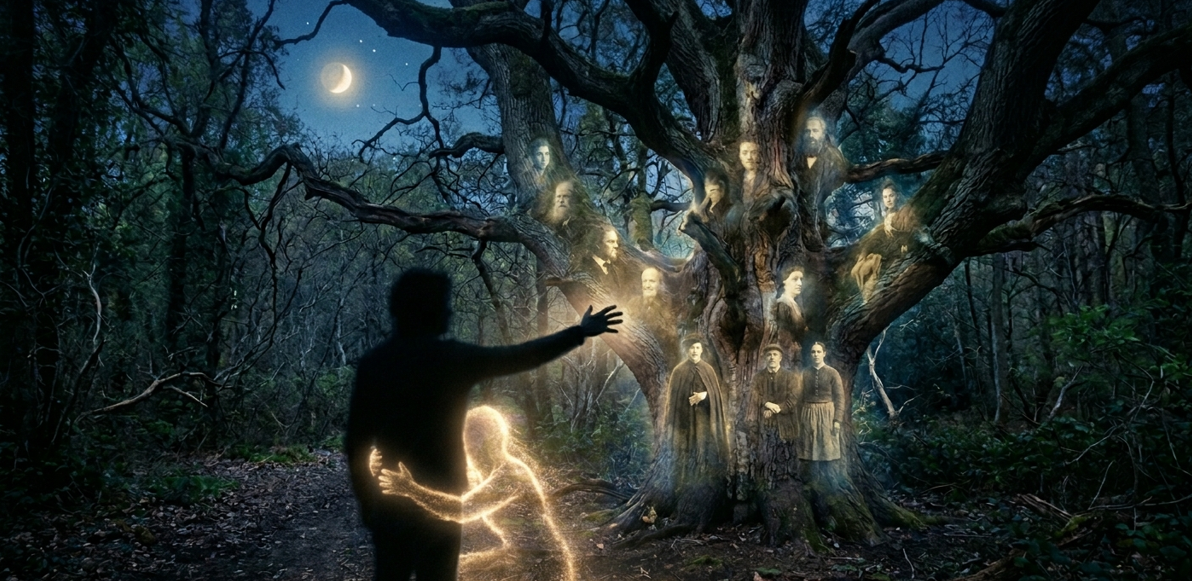
Au cœur d'un bois dense et nocturne, baigné par une lumière crépusculaire d'un bleu profond, se dresse un chêne monumental. Il est le protagoniste silencieux d'une révélation extraordinaire. Regardez bien son écorce. Elle ne protège plus seulement la sève ; elle abrite des vies. Des portraits, figés dans un sépia fantomatique, ornent les branches et le tronc comme des bijoux d'un autre temps.
Une femme au regard sévère, un homme en tenue de ville, un vieillard barbu... une douzaine de visages émergent de la matière brute, chacun racontant une histoire, un moment suspendu. Plus bas, près du sol, trois figures se détachent : un couple d'agriculteurs au labeur, une femme en robe de deuil, presque tangibles. L'arbre est devenu une galerie d'âmes, un arbre généalogique littéral où la famille respire à travers le bois.
L'Étreinte du Passé : Un Double Mystère
Face à ce colosse mémoriel, deux figures se tiennent. L'une, un homme en silhouette, est le pont entre notre monde et ce "au-delà" boisé. Son bras est tendu, non pas pour toucher l'arbre, mais pour recevoir une bénédiction, pour saluer sa lignée. C'est l'héritier, l'homme de notre temps.
Mais le véritable mystère réside à ses côtés. Une seconde silhouette, plus petite, presque à genoux, n'est faite ni de chair ni d'ombre, mais de lumière pure. Elle brille comme des particules d'ambre en suspension, son corps n'étant qu'une lueur contourée. Et dans un geste d'une tendresse inouïe, cette présence lumineuse enserre le corps de l'homme de ses bras invisibles.
Est-ce un guide ? Un protecteur ? Le souvenir matérialisé d'un parent bien-aimé ? Ou l'amour lui-même, sous sa forme la plus pure, qui le relie à cette arbre et à ceux qui l'ont créé ? Cette étreinte de lumière est le cœur de l'image, le moment où la douleur de la perte se transforme en une présence réconfortante.
Conclusion : Un Rappel Silencieux
Cette image est un rappel puissant : nous ne sommes jamais vraiment seuls. Nos ancêtres, nos histoires, nos amours passés sont inscrits dans le monde qui nous entoure. Il suffit parfois d'une nuit de pleine lune, d'une lumière d'ambre et d'un chêne ancien pour les voir, pour ressentir leur étreinte.
Et vous, quand vous marchez dans la forêt, qu'entendez-vous ? Un simple murmure du vent... ou le souffle de ceux qui vous ont précédé ?
📸 2026-06-06
General
📅 2026-06-06
The Future of Famille et souvenirs: An Open Letter to Our Familys
✏️ Written by Sylvain Lagacé
To you, my family, my loved ones,
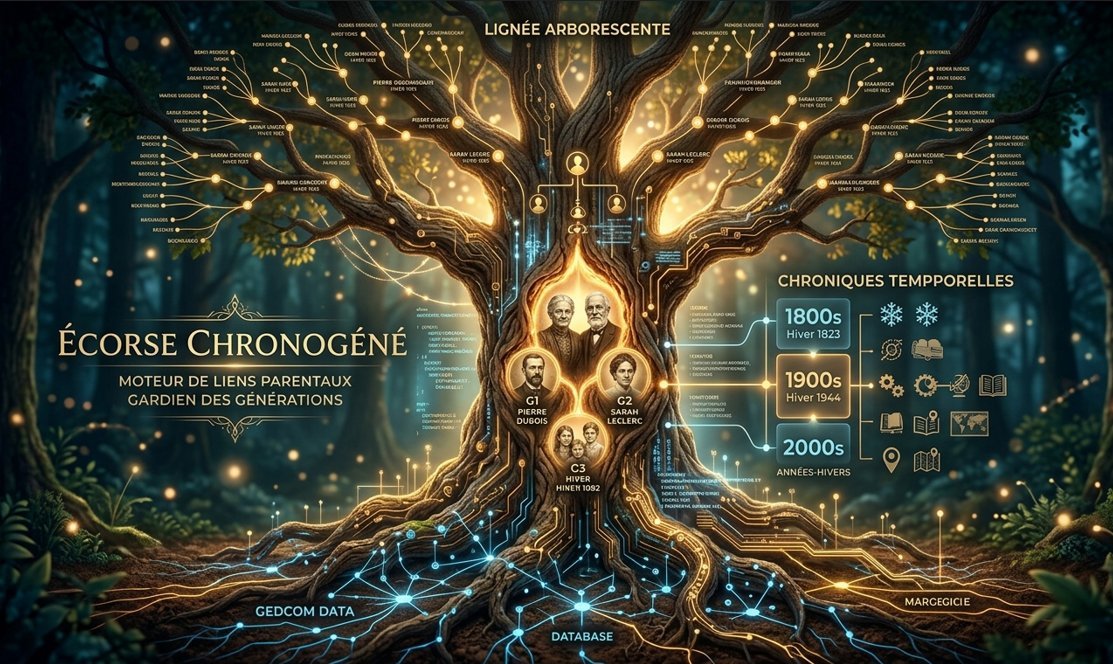
If I'm writing this today, it's to open my heart to you, but also to reassure you. These days, I'm spending a lot of time on development, completely absorbed in programming. Rest assured, everything is fine, and it's precisely about our Famille et Souvenirs website that I want to talk to you.
Far be it from me to abandon this project, quite the opposite! Today, our platform is working wonderfully: it's stable, efficient, and reliable. But you know me, I like to look ahead. I'm thinking about the future of this site, its long-term preservation... and, to speak frankly, about what will become of it the day I leave to join our ancestors.
Famille et Souvenirs doesn't belong to me. This site is our shared history, our roots, our laughter, and our shared memories. I am not the site; we are Family and Memories. And my dearest wish is that this legacy survives me.
However, there's a technical snag I need to resolve for this wish to come true. I'll explain it very simply, without any programming jargon.
Behind the scenes: the problem with the current system
To run the site today, I use what's called a "CMS" (a pre-built content management system). More specifically, we were using a cumbersome third-party genealogy tool. It's certainly a widespread piece of software for building family trees, but behind the scenes, it's a massive, complex system. Imagine a compressed archive with thousands of folders and lines of complex code. For someone like me who's immersed in it, it's manageable. But administering this system is a real computer labyrinth. It takes months to understand the basics and involves spending entire nights on help forums, most of which are in English. The problem, and you've surely noticed it, is also the site's visible side. The interface and its countless options often leave you feeling lost. When you want to add an event or information, you're faced with a sea of complex fields. You're essentially guessing, trying in good faith to integrate real information into what you think are the right places. The result is that I, on my end, constantly have to check, correct, and move your additions to the correct location so that the information displays properly. It's a constant behind-the-scenes job. If I were to designate one of you to take over tomorrow, it would be a poisoned chalice. Without solid technical knowledge, the site risks dying when I leave, because it won't be able to be managed. And that's something I simply can't accept. The solution: what I'm preparing So, what do we do? First, rest assured: the current website remains online and will continue to operate as usual. You can continue browsing it, adding your photos and documents, and growing our family tree. But in parallel, I've taken on a major challenge for several weeks now: I'm creating our own CMS, entirely custom-built. A system designed exclusively for us. My ultimate goal is to make it simple, user-friendly, ergonomic, and intuitive. No more headaches trying to add a date or an anecdote: the interface will be designed so that everyone can participate without fear of making a mistake or breaking the system. Furthermore, this project will allow future guardians of our history to manage the site in just a few clicks. If we ever need to change web hosting providers, all they'll have to do is copy and paste a folder, simply unzip it, and the site will be reborn elsewhere, instantly, without any coding knowledge required. Final thoughts This isn't an easy task; it requires a lot of energy. But in the last two weeks, I've made a lot of progress, and the project is taking beautiful shape. I don't yet know how much time I'll spend on it, but every hour invested is a gift for our shared future. I haven't forgotten Family and Memories. If I'm dedicating so much time to it now, it's out of love for our history and to ensure that our descendants, in ten, twenty, or fifty years, can still connect to it and know where they come from. The future guardian won't need to be a computer whiz; they'll just need to love our family. And I know you all already do that very well. Thank you for your support and patience, and please keep our memories alive!
📸 2026-09-06
General
📅 2026-09-06
A custom-built home for our family: Behind the scenes of our new website!
✏️ Written by Sylvain Lagacé
You're probably starting to get curious about whether our own CMS project will actually see the light of day. Here's where we stand and why this change will transform everything!
Now that the workis well underway,it's time to unveil this exciting porject.
The project is hosted here : https://projet.familleetsouvenirs.com/index.php?lang=en&page=home.
1. Why build our own platform?
For years, our website relied on traditional genealogy software. While useful for logging names and dates, let’s be honest: those platforms are often rigid, overly technical for casual visitors, and lack personal warmth. Navigating through endless menus can be intimidating, and relatives often hesitate to participate for fear of making a mistake.
We deserved more than a cold database: we deserved a true digital family hearth, warm, inviting, and accessible to all generations.
2. What makes our new space unique:
-
🛋️ The Family Lounge (A lively gathering place):
Genealogy should not be a lonely pursuit! The Lounge lets us connect, share news, discuss mysteries in our lineage, and collaborate to overcome genealogy brick walls. -
🌿 Gentle, secure family privacy:
Our family memories are precious. Access to contemporary details and private pictures is now safeguarded through a clean, semi-private membership request process. Relatives can easily request their access directly from the keeper of memories. -
📖 Chronicles that bring history to life:
Our ancestors were living, breathing people with dreams, trials, and triumphs. Our Chronicles section puts their stories, oral traditions, and historical journeys front and center. -
🎲 The Recreation Area (Learning through play):
To spark curiosity in younger generations, we have built interactive trivia and memory games directly featuring our authentic family photographs! -
📱 Seamless on phones and tablets:
Crafted with an elegant vintage ambiance and warm parchment tones, the platform is fully responsive and pleasant to browse, whether you're at a desktop or relaxing with your smartphone.
3. What's next?
The foundations are rock-solid, core features are ready, and fine-tuning happens every day. Very soon, we will all be able to step into this new home together.
Thank you for your warmth, curiosity, and encouragement. This site is crafted with love so that our shared legacy keeps shining bright!
📸 2026-06-19
Deschênes
📅 2026-06-19
Origin of the name Deschênes
✏️ Written by Sylvain Lagacé
Column: Deschênes, the Tree That Hides a Mountain of History
Have you ever taken the time to observe an oak tree? It is the king of the forest, a symbol of strength and endurance. For thousands of families here, it is not merely a tree; it is an identity. Today, we dive into the roots of the surname Deschênes.
A Name Shaped by the Landscape
Originally, "Deschênes" was what is known as a topographic surname. In the Middle Ages, before the advent of civic addresses, people were identified by their surroundings. The earliest bearer of the name was simply someone who lived near an oak forest (des chênes) or an estate marked by these majestic trees.
In France, the name took root across several regions—from Normandy to Charente—leaving behind variants such as Deschêne, Deschesnes, and Duchêne.
The Epic of Pierre Miville, "The Swiss"
The story takes a captivating turn upon crossing the Atlantic. If your last name is Deschênes and your roots trace back to Quebec or Acadia, there is a strong chance your founding ancestor was Pierre Miville.
Hailing from the Canton of Fribourg, Switzerland, Pierre was far from an ordinary settler. Before setting foot in New France, he was a man of the sword. A career mercenary, he served in the Swiss Guards in service to the French Crown, notably at the citadel of Brouage in Saintonge. In this strategic port town, he married Charlotte Maugis around 1631, and together they welcomed six children: Marie, François, Aimée, Madeleine, Jacques, and Pierre.
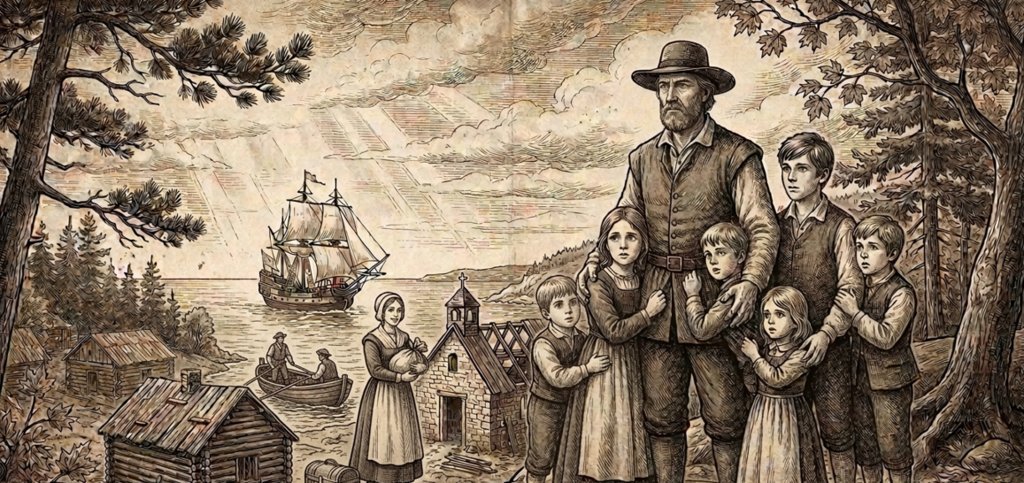
In 1649, while the colony was still precarious, the Miville family took the leap to Quebec. Pierre, already around 45 years old, did not arrive alone: he crossed with his wife and all six children—a rare feat at a time when large families seldom crossed the Atlantic together. His military background was immediately put to use in a colony embattled by the Iroquois Wars.
The moniker "le Suisse" followed him everywhere, but it was the addition of "dit Deschênes" that would define his lineage. This nom de guerre or estate name may have referred to the oak groves surrounding his lands or, as some historians suggest, an echo of his service in Brouage.
Pierre's ambitions were vast. In 1665, Governor de Mésy granted him land on the south shore of the Saint Lawrence River, within the Seigneury of Lauzon. This area, dubbed the "Canton des Suisses" (Swiss Canton), was intended to welcome fellow countrymen from Fribourg. While the broader Swiss settlement project never fully materialized, Pierre firmly rooted his lineage there. By his death in 1669, his family was well established: his sons Jacques and Pierre ensured the survival of the name, while his daughters married into prominent pioneer families, turning him into the forefather of an army of Deschênes across North America.
The Visionary "Swiss Canton" Project
Pierre Miville’s ambitions reached far beyond farming his own plot. The 1665 grant on the Lauzon coast (present-day Lévis) formed the bedrock of a unique settlement endeavor: Pierre envisioned establishing a small Swiss enclave by recruiting families from his home canton of Fribourg.
Although authorities eventually restricted foreign immigration in favor of French settlers, Pierre placed his sons on adjacent parcels of land, each measuring three arpents of frontage. This family hub became one of the first enduring settlements on the south shore of the Saint Lawrence.
Pierre’s Sons: Between the Soil and the Wild
Pierre Miville’s children mirrored the duality of early French-Canadian settlers: farm builders on one hand, fearless coureurs des bois on the other.
-
Jacques Miville dit Deschênes (the younger son): He truly anchored the surname in Canadian soil. In 1674, he obtained a land grant at Grande-Anse (Sainte-Anne-de-la-Pocatière). By marrying Catherine de Baillon, a French noblewoman, he elevated the family’s social standing. They are the direct ancestors of the vast majority of today's Miville-Deschênes families.
-
François Miville: Like his brother Jacques, he was an early coureur des bois. Records show he explored far-flung territories, traveling as far as the Gaspé Peninsula in search of mineral deposits, carrying forward his father’s adventurous spirit.
-
Pierre Miville the Younger: He remained tied to the Lauzon lands, preserving and expanding his father’s estate on the south shore.
Historical Facts & Heritage
-
Master Carpenter: Before his military career, Pierre was a skilled master carpenter. This trade proved indispensable in erecting his family’s first shelters on the frontier.
-
A Prolific Legacy: Today, the Miville-Deschênes lineage ranks among the ten pioneer families with the largest surviving descendance in Quebec.
-
The Swiss Connection: Genetic genealogy (Y-DNA) has confirmed the family's Fribourg origins, proving their exclusive Y-chromosome marker traces directly back to medieval Swiss stock.
Charlotte Maugis: The Anchor of the Venture
If Pierre Miville was the builder, Charlotte Maugis was the mortar holding it together. Originally from Saint-Germain-de-Marennes, France, she exemplified the resilience of the first generation of settler women.
-
Steadfast Management: While Pierre managed land grants and her sons ventured into the wilderness, Charlotte oversaw the daily survival of a six-child household in an unforgiving climate. Outliving her husband by seven years, she preserved the family's holdings in the "Swiss Canton."
-
Clan Survival: Crossing an ocean plagued by scurvy and shipwrecks, her endurance ensured that every single one of her children survived and thrived—an extraordinary outcome for the 17th century.
Catherine de Baillon: An Alliance with French Nobility
The 1669 marriage between Jacques Miville dit Deschênes and Catherine de Baillon remains one of the family’s most notable chapters.
-
An Exceptional Fille du Roy: Unlike most Filles du Roy of modest means, Catherine belonged to the French nobility, with a verified lineage tracing back to the kings of France and England (including Charlemagne and Saint Louis).
-
A Lasting Pedigree: Marrying the son of a Swiss mercenary lent immense social status to the Miville name. Modern genealogists have confirmed that all descendants of this couple—widespread throughout the Bas-Saint-Laurent—share this European royal descent through Catherine's bloodline.
-
Pioneering at Grande-Anse: The couple settled in La Pocatière, where the "Deschênes" surname became a cornerstone of the region. Accustomed to French manor life, Catherine lived out her days clearing Canadian forest alongside Jacques.
A Living Legacy
The year 2024 marked the 375th anniversary of Pierre Miville’s arrival in Canada, commemorated by the unveiling of a monument in La Pocatière on the ancestral lands of Grande-Anse. It stands as a reminder that the surname is not just a label, but a testament to survival and deep roots in the Lower Saint Lawrence and across the continent.
Carrying the name Deschênes—whether shared by artists like Josée Deschênes or historians like Gaston Deschênes—means remembering descent from a daring Swiss pioneer, an indomitable matriarch, and a lineage built to weather the storms just like the oak itself. The next time you walk past an oak tree, spare a thought for Pierre Miville and the living forest of descendants he planted nearly four centuries ago.
🍃 No stories match your search. Try other keywords!
✒️ Family Memories & Guestbook Register
Add your testimony, historical detail, or word of affection to enrich this family memory.
✨ Your memory has been successfully recorded in the register!
📜
Guestbook & Family Memories
To leave a memory, anecdote, or warm message under this chronicle, please sign in to your family member area.
🔑 Sign in to contribute